
7 Warning signs your accounting firm has outgrown its Software stack
Introduction
Nobody decides to outgrow their software. It happens quietly one client, one hire, one MTD update at a time until the tools that felt fine two years ago are working against you. Here are seven signs worth taking seriously.
How this relates to us: Sliq360 is built for firms at exactly this point past spreadsheets, not interested in enterprise software built for firms ten times their size.
The Problem?
Most firms don’t choose their software once and revisit it deliberately; they add a tool whenever something breaks, and keep adding until the “stack” is really just a pile of quick fixes from different years. It works well enough that nobody questions it, right up until growth exposes every seam at once: a missed deadline, a client complaint, a new hire who takes a month to become useful. By then it’s not a minor annoyance. It’s a systems problem hiding as a series of one-off mistakes.
- Nobody Can Say What’s Outstanding Without Checking Three Places The three-tab shuffle
Ask a straightforward question “where are we on the Patterson accounts?” and watch what happens. Someone opens the task app. It’s not there, so they check the spreadsheet. Still nothing conclusive, so they scroll an inbox looking for the last email thread. Ten minutes later, you have an answer, but you’ve also just watched three “systems” fail to do the one job a system is supposed to do: tell you what’s true, immediately. That’s not a system. That’s three partial ones, stitched together by whoever happens to remember where things were last left.
- HMRC and Companies House Deadlines Live in One Person’s Head Your compliance safety net has a single point of failure
Every firm has one person who “just knows” when the Confirmation Statement is due, who’s tracking the Self Assessment cutoffs in a mental list nobody else has access to. It works, right up until it doesn’t: they’re off sick during the busiest week of January, they leave the firm, or they’re simply juggling too much to catch the one deadline that slips through. At that point, your compliance safety net isn’t a system, it’s a person’s memory, and memory doesn’t come with a backup.

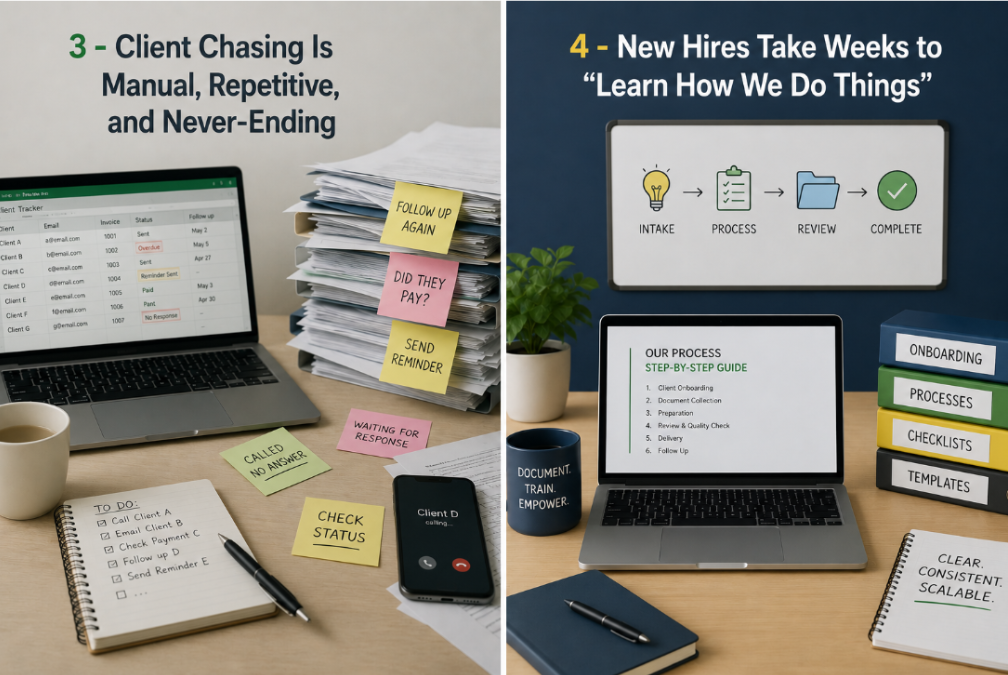
- Client Chasing Is Manual, Repetitive, and Never-Ending The most expensive email you’ll never bill for
You’ve sent the request. Then the reminder. Then the “just following up” email, then the phone call, then finally the document arrives, three weeks later than it should have. Multiply that by every client, every job, every month, and you’ve got a genuinely significant chunk of your team’s week spent on something that was never priced into any fee. It’s not client service. It’s unpaid admin wearing client service’s clothes.
- New Hires Take Weeks to “Learn How We Do Things” If it’s not written down, it’s not a process it’s a person
A capable new hire should be productive fast. Instead, they spend their first month shadowing someone, asking “how do we usually handle this?”, and slowly reconstructing a process that exists nowhere except in colleagues’ heads. That’s not an onboarding problem it’s a sign that your firm’s know-how lives in people rather than in a system, which means every departure takes a piece of institutional memory with it, and every hire has to rebuild it from scratch.
- You’re Paying for 8+ Tools Held Together by Zapier The stack that costs more the longer you don’t look at it
A client portal here, an e-signature tool there, a task manager nobody quite trusts, and a set of Zapier automations connecting them that someone set up eighteen months ago and nobody’s touched since. Individually, each subscription looks harmless. Together, they’re an expensive, fragile mess, one broken Zap away from a client thinking you lost their documents, because, functionally, you did.


- Reporting Means Someone Manually Pulling Numbers Together Decisions made on data that’s already out of date
If “how’s the firm doing this quarter?” triggers a scramble to export, copy, and reconcile numbers from three different places, you’re not looking at real-time insight you’re looking at a snapshot that was already stale by the time it was finished. Firms making pricing, staffing, or capacity decisions on week-old numbers aren’t being careless. They’re just working with the only data their systems will give them.
- Growth Means More Admin, Not More Margin The scaling problem nobody notices until it’s too late
A new client should mean more revenue. In a firm running on a fragmented stack, it also quietly means more chasing, more re-entry, more manual tracking costs that scale right alongside the client base instead of staying flat. It’s the kind of growth that looks good on the top line and barely moves the bottom one, because every new client is dragging the same inefficiencies in with them.
The Fix?
None of this requires ripping everything up and starting from scratch. It requires one system where jobs, deadlines, client documents, and reporting live together so the signs above stop being separate problems and become one thing to solve.
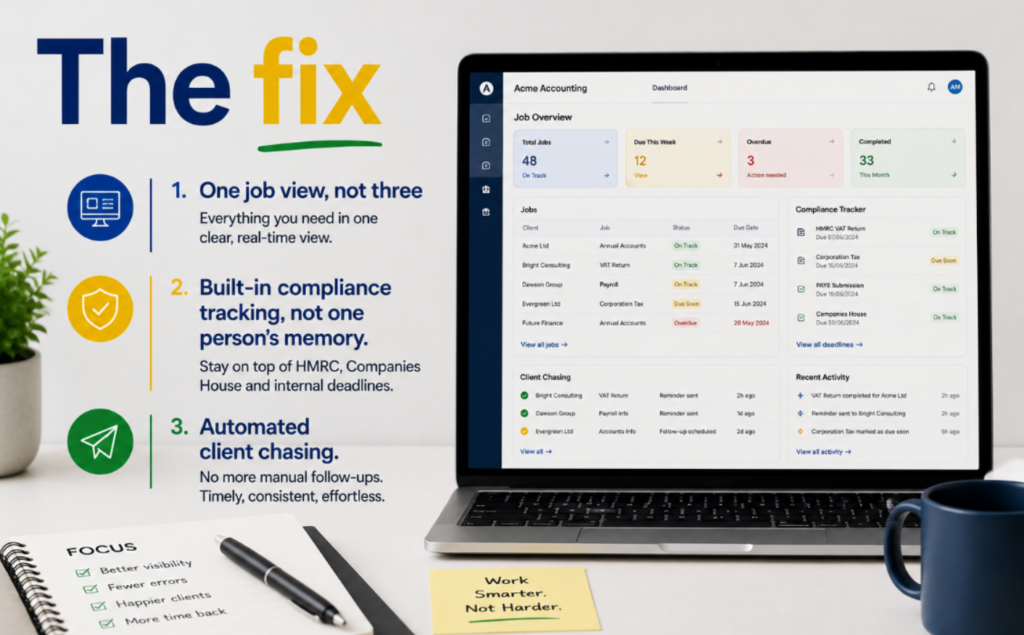
- One job view, not three. A single system where task status, client documents, and communication all live against the same job record. Ask “where are we on the Patterson accounts?” and the answer is one click away not a three-tab search.
- Built-in compliance tracking, not one person’s memory. Automated deadline tracking for HMRC and Companies House dates, visible to the whole team not just the one person who happens to hold it in their head. If they’re off sick, the deadline still gets flagged.
- Automated client chasing. Reminders that fire on their own until a document arrives, instead of a staff member manually re-sending the same request. Chasing still happens, it just doesn’t cost anyone billable time to do it.
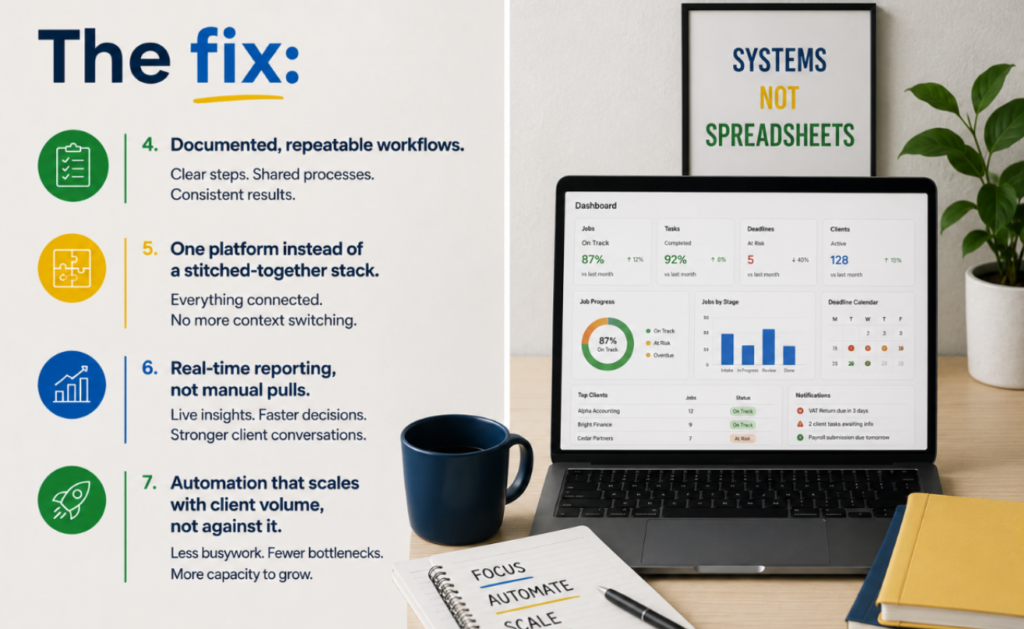
- Documented, repeatable workflows. Standard processes are built into the system itself, so a new hire follows the same steps every job requires instead of shadowing a colleague and reconstructing “how we do things” from scratch.
- One platform instead of a stitched-together stack. Client portal, e-signatures, task management, and accounting software sync, natively connected no Zapier holding it together, no single broken automation putting a client’s documents at risk.
- Real-time reporting, not manual pulls. Dashboards that reflect the firm’s numbers as they happen, so a “how’s the quarter going?” question gets answered with current data not a reconstructed snapshot from a week ago.
- Automation that scales with client volume, not against it. When chasing, re-entry, and status tracking are automated rather than manual, adding a new client adds revenue without a proportional rise in admin so growth actually improves margin instead of quietly eating it
None of these are dramatic alone. That’s why they’re easy to miss until two or three stack up and start costing real margin, or a client’s confidence. It’s not a staffing problem. It’s a system one, and it’s fixable.
Stop patching a stack that’s already outgrown.
-> Claim your free trial of Sliq360
-> See what running your firm on one system feels like