
MTD Is Here: How UK Accounting Firms Can Automate Compliance and Reduce Admin Work ?
Making Tax Digital for Income Tax is no longer something UK accounting firms can put off. The first quarterly reporting cycles are underway, and the real challenge isn’t simply submitting updates to HMRC. It’s managing everything that needs to happen before submission.
It’s Monday morning during a quarterly reporting cycle. You open your spreadsheet to check which clients have submitted their records. Eleven are marked as complete. Four are still blank. Two say “waiting on records”, but you’re not sure when those notes were last updated.
You contact one of the clients. “Oh,” he says, “I thought you were taking care of that.”
You weren’t. Or you were, but the records you needed never arrived, and nobody noticed because there was no clear process to flag what was missing.
That’s the real MTD challenge for a small accounting practice. It’s not just about having software that communicates with HMRC. It’s about keeping clients, documents, deadlines and your team organised throughout the reporting cycle.
And it’s happening at scale. HMRC reports that more than 436,000 sole traders and landlords have already sent their first quarterly update. Behind each of those updates, someone was chasing records.

What MTD for Income Tax changes for a small firm
Making Tax Digital for Income Tax requires eligible sole traders and landlords to maintain digital records and submit quarterly updates using HMRC-compatible software.
The requirements apply to taxpayers who meet the qualifying income thresholds, with the rollout extending to progressively lower income levels.
Affected taxpayers must:
- Keep digital records of their business income and expenses.
- Use HMRC-compatible software to maintain their records.
- Submit quarterly updates to HMRC.
- Complete a final declaration to confirm their annual tax position.
These requirements mean more regular contact with clients, more records to manage and more work to coordinate throughout the year. HMRC has published an Agent Update dedicated to MTD for Income Tax, which is a useful starting point for briefing your team.
For accounting practices, the challenge isn’t simply understanding the new requirements. It’s finding a way to manage the additional workload without overwhelming your team.

Why the initial transition period can feel easier than it is
Some firms may feel relatively relaxed about MTD because HMRC has confirmed a first-year easement on quarterly update penalty points for new taxpayers joining in April 2027 (read HMRC’s announcement)
However, this shouldn’t be mistaken for a reason to delay improving internal processes.
Once the penalty system applies, missed quarterly update deadlines can result in penalty points. Once a taxpayer reaches the required points threshold, a £200 penalty applies. Further missed deadlines can trigger additional penalties.
The penalty is imposed on the taxpayer, but accounting firms will often be the first to hear about it.
That’s why building reliable processes matters. Without clear workflows, consistent client communication and proper deadline tracking, managing a growing MTD client list can quickly become overwhelming.
If your process only works because the initial transition period is more forgiving, it hasn’t really been tested yet.

Where the time actually goes
Submitting a quarterly update is only the final step. The administrative work often starts weeks earlier.
Think about what happens during a typical reporting cycle:
- Contacting clients to request their records.
- Following up with those who haven’t responded.
- Checking which documents have arrived and which are still missing.
- Reviewing information before it’s ready for submission.
- Tracking deadlines across different clients.
- Making sure every task has a clear owner within the team.
Now consider a firm with 40 clients within the scope of MTD.
That’s 160 quarterly updates every year.
If the team spends an average of 30 minutes chasing records, checking progress and following up for each update, that adds up to 80 hours of administration per year.
That’s valuable time spent coordinating work before the actual accounting and submission process is even considered.
Now imagine expanding your MTD client base by another 25 clients.
That’s another 100 quarterly updates each year, potentially adding 50 hours of administrative work using the same assumptions.
These figures are illustrative, but they show how quickly repetitive tasks can accumulate. The wider picture looks similar: a Bright survey found that six in ten UK practices are spending more time per client since MTD began.
For a small practice, that’s valuable time taken away from client advice, billable work and business development.

Why spreadsheets and email stop working
Most small accounting firms already have a system for managing deadlines. It might be an Excel spreadsheet, a shared calendar, an email inbox or a combination of all three.
These tools can work when the client list is small. But as quarterly reporting becomes part of everyday operations, keeping everything organised becomes increasingly difficult.
- Deadlines become harder to track: Different clients may follow different update periods. Some use standard periods, while others may choose calendar-based periods. Managing these variations manually creates additional work and increases the risk of oversight.
- Client communication becomes fragmented: One client replies by email, another sends documents through a separate platform, and another simply forgets. Your team ends up searching through inboxes to understand what has been requested and what is still missing.
- Nobody has a complete picture: A spreadsheet might show that a task is pending, but does it show who is responsible, when the client was last contacted and what documents are outstanding?
- Without a shared view, important information often stays in individual employees’ inboxes or memories.
- Manual follow-ups consume valuable time: Sending reminders individually might be manageable with a small client list. With dozens of clients and recurring reporting cycles, the process becomes repetitive and difficult to scale.
The problem is not that your team lacks organisation. It is that the tools were never designed to coordinate this level of recurring work. AccountingWEB has made a similar point: firms that prepared for MTD around software compatibility have solved the filing, but not the workload behind it.

What a workable process looks like
Firms that manage MTD effectively don’t necessarily need more people to chase clients. They need a better way to organise each reporting cycle, so that fewer tasks depend on manual follow-ups.
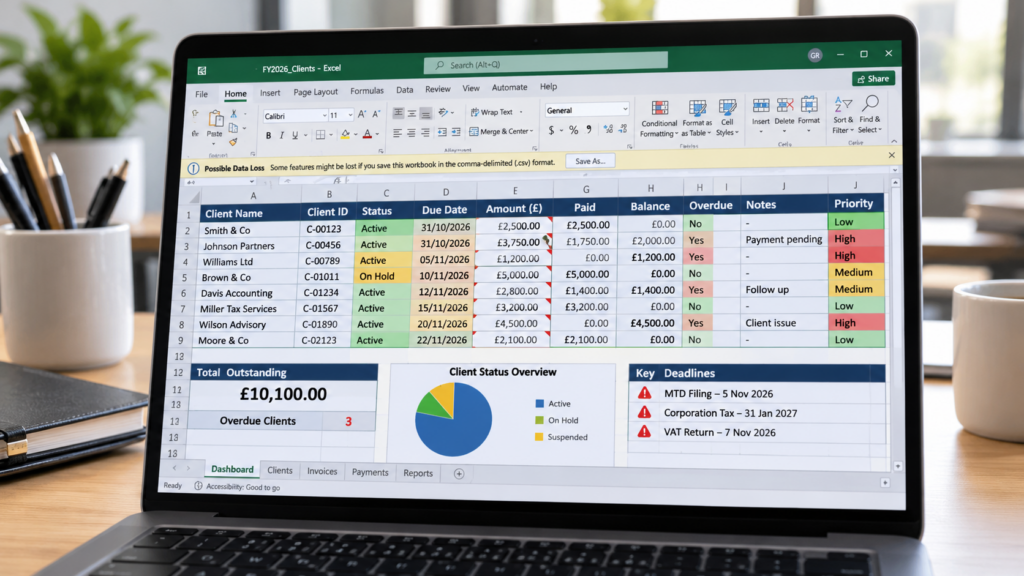
- One place that shows every deadline. Each client, each quarter and each due date should be visible, with clear responsibility for every task. You can see at a glance what’s due and what’s overdue without opening multiple spreadsheets and hoping they’re up to date.
- Recurring work that creates itself. Set up quarterly cycles once per client and let recurring workflows generate the relevant tasks. You don’t need to rebuild the same process for every reporting period. Adjustments for individual clients, such as different accounting periods, can be managed without disrupting the rest of the workflow.
- One request per quarter, not a thread of emails. Give clients a clear list of what’s needed, with a central place to upload their documents. Your team can see what’s arrived and what’s still missing without scrolling through weeks of replies.
- Reminders that go out without you. Set up polite, regular reminders at intervals that suit your process. Automated notifications help ensure clients receive requests before their records are needed.
- A named owner for every update. Assign responsibility for each client and reporting period. When something is overdue, you can quickly identify who’s handling it and what needs attention.
The goal isn’t to eliminate every client interaction. Some clients will always need personal attention. It’s to reduce repetitive coordination so your team can focus on the work that genuinely requires their expertise.

How Sliq360 handles the work around MTD
HMRC-compatible software is responsible for maintaining digital tax records and submitting quarterly updates. SLIQ360 serves a different but equally important purpose.
It is a Practice Management System designed to help accounting firms organise the operational work surrounding their clients and compliance deadlines.Instead of managing client requests in one tool, tasks in another and documents somewhere else, SLIQ360 brings essential practice management functions together in one platform.
For MTD-related workflows, this includes:
- Deadline and task management: Keep track of client deadlines, upcoming quarterly updates and outstanding work through a centralised dashboard.
- Recurring workflows: Create repeatable processes for quarterly reporting so that tasks are generated consistently without rebuilding the same workflow every cycle.
- Automated client reminders: Reduce manual follow-ups with scheduled notifications for clients and team members.
- Client portal and document management: Give clients a central place to access requests and upload documents, making it easier for your team to track what has been received.
- Team responsibility and workload visibility: Assign tasks, monitor progress and identify bottlenecks before they affect deadlines.
- Integrated practice management: Connect deadlines, workflows, client records, document requests,and time tracking within one platform.
The difference is not simply having another tool to manage MTD. It is having a clearer operational picture of your entire practice.
Your team knows what needs to be done, clients know what is expected of them, and managers can see where work is progressing or getting stuck.

Stay Ahead with a Better MTD Process
MTD is changing the way accounting firms organise their work. As more sole traders and landlords enter the system, the administrative pressure will continue to increase.
The firms that adapt successfully won’t necessarily be the ones working longer hours. They’ll be the ones with better processes, clearer responsibilities and the right systems in place.
You became an accountant to advise clients, solve problems and help businesses grow. Not to spend hours chasing missing documents or searching through emails to find out which quarterly update is still outstanding.
Ready to get MTD out of your spreadsheet?
Discover how SLIQ360 brings client management, workflows, deadlines and documents together in one Practice Management System.
Book your SLIQ360 demo today and build a more organised, efficient accounting practice.